French Open 2026: Key stories from Roland Garros so far, as Jannik Sinner’s shock defeat leaves tournament wide open
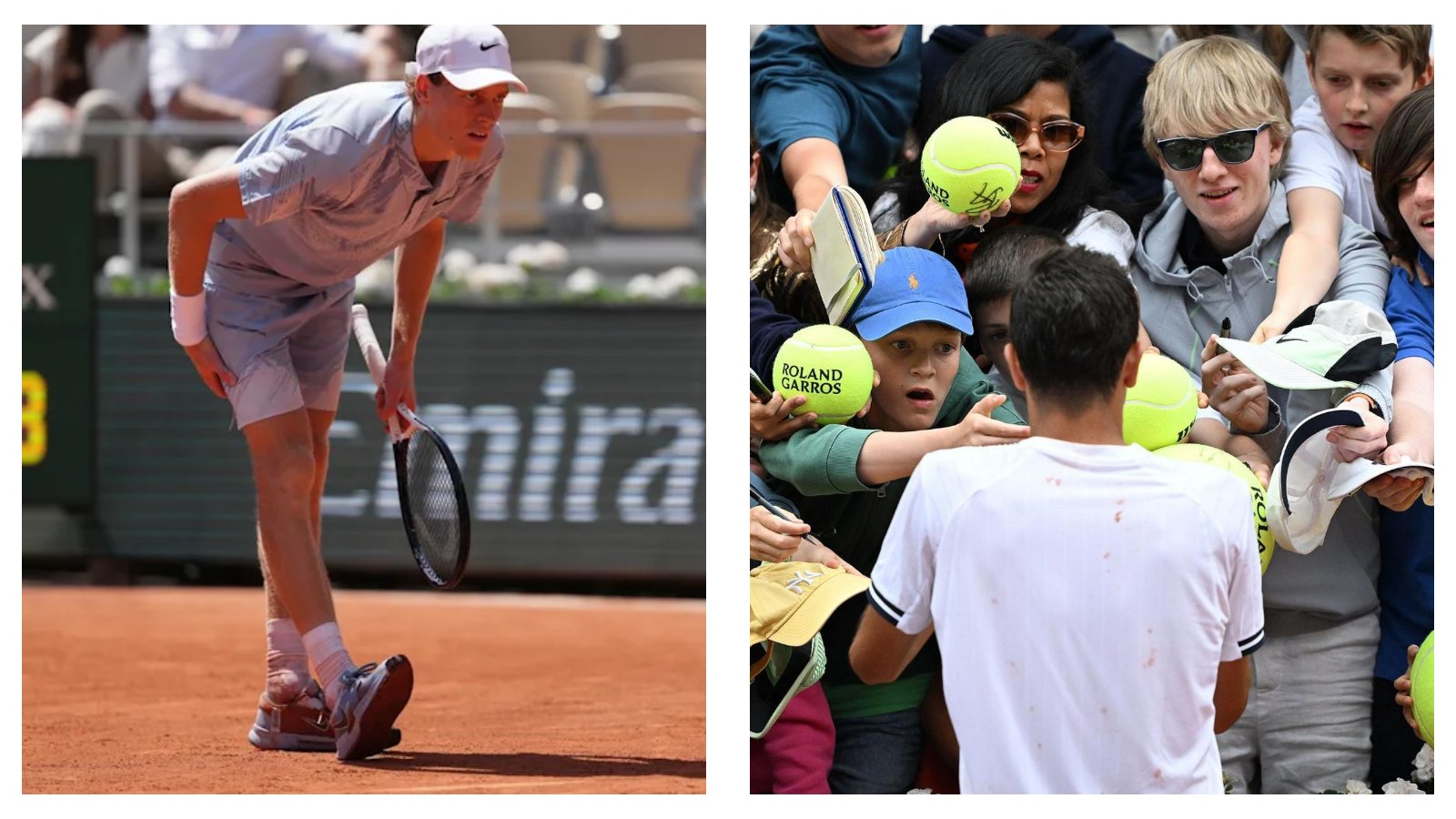
Chaos has unfolded across the men's singles draw at this year’s French Open, with half the Top 10 seeded players crashing out in the opening two rounds - including world #1 and overwhelming tournament favourite Jannik Sinner.
What’s more, a handful of players have pulled off unlikely victories, turning the competition into a remarkably open field where almost anyone seems capable of advancing deep into its latter stages.
Here, Sports News Blitz writer and tennis fan AJ Becker takes a closer look at the most salient events that have taken place on the Parisian clay in the past seven days.

Sinner crashes out in round two
Prior to the start of the tournament, it was felt that the only set of circumstances in which an opponent could even become competitive against Sinner was if the Italian ran into physical issues - something that has stricken him at various points during his career.
In the extreme daytime heat on Thursday, May 28, this was precisely what unfolded against Argentina’s Juan Manuel Cerúndolo.
From a seemingly unassailable position (two sets and 5-1 ahead), Sinner’s body visibly wilted, causing the world number one to lose 18 of the next 20 games.
That is not to take anything away from Cerundolo, younger brother of the seeded Francisco, who achieved what was by any measure a stunning result, unique in recent grand slams and with major consequences.
In doing so, he halted Sinner’s 30-match winning streak - as well as his 23-match run of wins over left-handers - and has helped make the draw resemble an ATP 500 event, creating opportunities for himself and the rest of the field.
Marathon matches
Playing tennis on clay is not for the faint of heart...or attention span!
Whilst longer rallies are to be expected on slower surfaces, it is nonetheless worth noting that eighteen of the 48 matches in rounds two and three went the distance, with some extending well beyond four hours.
Sinner’s compatriots, the two Matteos (Berrettini and Arnaldi), prevailed in five-hour contests decided by a ‘super tie-break’.
The former has matched his quarter-final placing attained at his last Roland Garros appearance - some five years ago - whilst the latter is presiding over a superb resurgence, having dropped out of the Top 100 in late April with a hideous 2-9 record for the season.
Sinner’s conqueror Cerúndolo, meanwhile, took epic drama to new extremes by outlasting Martin Landaluce in a slugfest that exceeded six hours!
He thereby successfully avoided the ‘after the Lord Mayor’s show’ slump that too often follows a landmark underdog slam victory.
It would have been a serious disappointment if the Argentine had opened up the draw so dramatically, only to depart it immediately afterwards.
READ MORE: ATP Tour news: Rome is where the heart is for Jannik Sinner as clay Masters hat-trick is completed
Next Gen talents rise to the occasion
The notion that there are players born in the second half of the 2000s with potential to challenge the Sinner-Alcaraz domination has been common currency for some time now - even if it was also thought that the slams have ceilings through which they cannot currently pass.
Spaniard Rafael Jodar has fully answered any doubts as to whether he could physically handle the demands of best-of-five-set tennis, even though his run has not been without its exertions.
The 19-year-old, in only his second grand slam participation, has battled his way past Alex Michelsen and countryman Pablo Carreño Busta in back-to-back five-set affairs.
Considering his current momentum and the rich history Spanish players have at Roland Garros, Jodar has every reason to believe he can progress further - and he is in good company.
Brazil’s Joao Fonseca, for all his talent and potential, arguably lacked a defining victory against an elite opponent in a tournament of this magnitude.
On Friday, May 29, he ticked that box in spectacular fashion by eliminating three-time champion Novak Djokovic from two sets down.
Even more impressively, Fonseca never allowed Djokovic any way back into the contest, displaying remarkable composure and tenacity.
Another exceptional performance against two-time runner-up Casper Ruud followed, setting up a mouthwatering quarter-final with 20-year-old Jakub Mensik.
Mensik’s rise has also been rapid, though he had previously made only a minimal impact upon the slams due to deficits in his physical endurance.
That narrative has now been transformed, as the Czech survived a gruelling five-set battle with Mariano Navone, produced a remarkable turnaround against Alex de Minaur and found a way past Andrey Rublev in a close round-of-16 clash.
Whatever happens henceforth, Mensik will know that his body can handle the physical demands of prolonged battles at the highest level.
Kouame the local hero
French sports fans have had much to celebrate in the past 48 hours, though their foremost tennis event offered minimal local representation by the time the round of 32 got underway.
With several long-serving players (Gasquet, Tsonga, Simon, soon Monfils) having exited the playing scene in recent years, French tennis is searching for a new generation. 17-year-old Moise Kouame - about whom I wrote on this website back in February - is increasingly being viewed as the best of their progeny.
The Fédération Française de Tennis have already started handing him regular opportunities.
Kouame last week proved the hype was justified by inflicting a dominant straight-sets win over former semi-finalist Marin Cilic, and showing real composure to edge past fellow slam debutant Daniel Vallejo in a tense five-hour battle.
In doing so, he became the first player born in 2009 to win a Grand Slam match and the youngest man to reach the third round of a major since Rafael Nadal in 2003.
Whilst Alejandro Tabilo ended his participation at that stage, a Top 200 debut is now within touching distance for Kouame, who began the year at #876.
YOU MAY ALSO LIKE: Tennis profile: Who is Moïse Kouamé, the rising star of French tennis?

Could it be Zverev’s time at last?
Since his Roland Garros main draw debut a decade ago, Alexander Zverev has harboured realistic ambitions of one day lifting a Grand Slam trophy.
His maiden appearance in 2016 ended in a third-round defeat to Dominic Thiem, the Austrian who was sometimes dubbed a ‘nearly man’ for falling short in successive finals (2018 and 2019).
Despite having squandered several golden opportunities throughout his career, fate may now have dealt the German an ace - with Sinner, Alcaraz and Djokovic all out of the equation - to finally shed his own ‘nearly man’ label and claim the slam crown that has eluded him for so long.
While the current scenario is auspicious, it also engenders substantial pressure and expectation - something the 29-year-old has a history of being largely unable to deal with, at least in a grand slam context.
That said, the Hamburg native has dispatched his opponents with a minimum of fuss and avoided any long five-set battles so far.
The next few days will reveal whether Zverev can grasp and turn into reality the best opportunity to claim a grand slam title that may ever fall his way.
If he fails to capitalise this time, it may leave another painful scar that proves impossible to recover from mentally.
Final French Open for Djokovic?
The aforementioned Fonseca defeat marked only the second time in Djokovic’s long grand slam career that his opponent successfully overturned a two-set deficit - after Jurgen Melzer at the 2010 French Open - and the first ever occurrence of a teenager ending the Serb’s interest in a slam.
Whilst it would be churlish to draw too many conclusions, there seemed to be a distinct air of finality surrounding his performance.
To compete in a slam having just turned 39 would be satisfaction enough for most athletes, but it ranks as a disappointment to those - including Novak himself - expecting another age-defying success story.
READ NEXT: WWE news: Clash in Italy – Jade Cargill shines as Cody Rhodes vs Gunther ends in controversy