2026 UK Open darts: Five key takeaways from a weekend that delivered a mixture of the familiar and the unpredictable
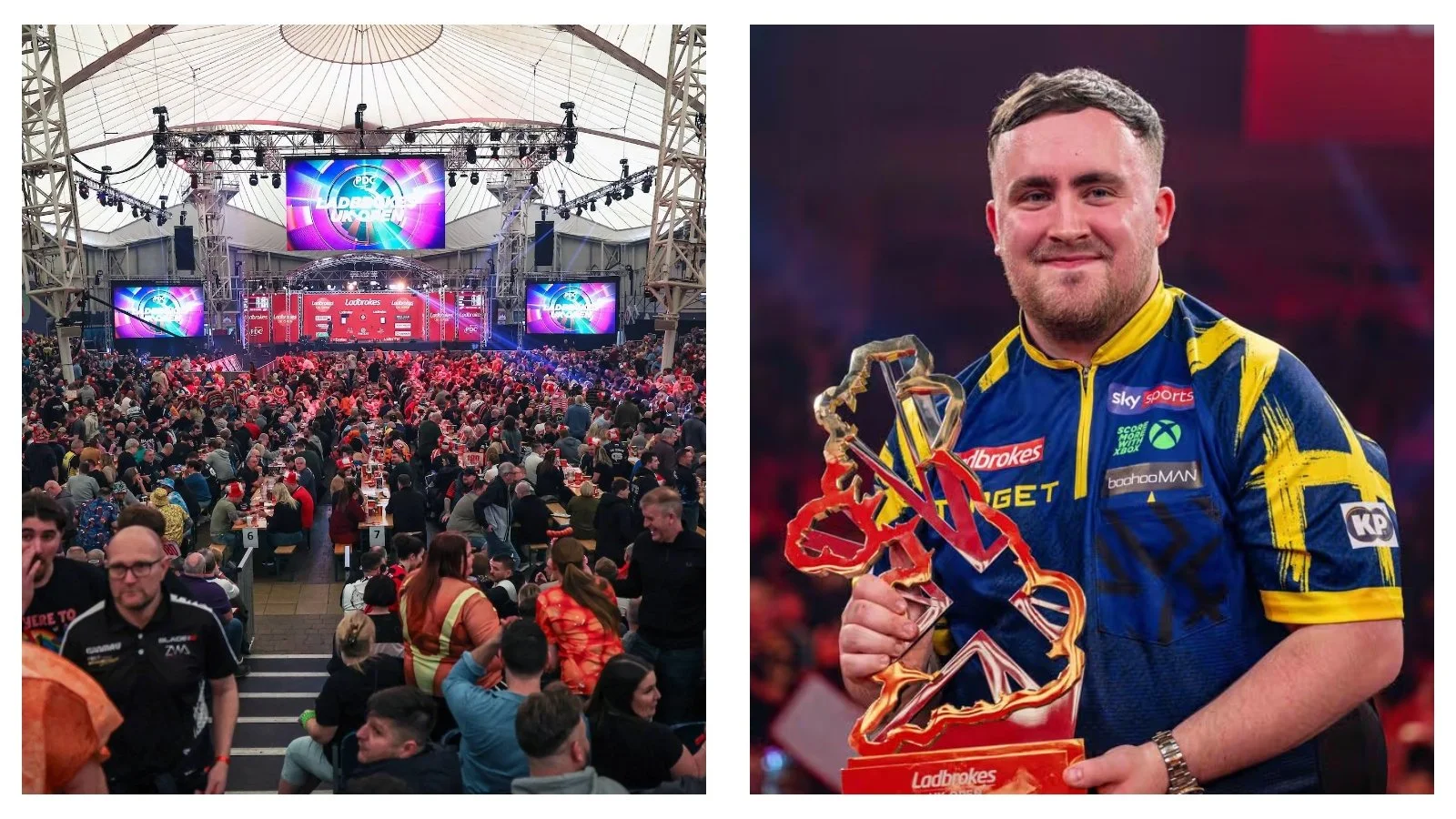
Over the weekend of Friday, March 6 to Sunday, March 8, 160 darts players gathered in Minehead for the UK Open - a tournament open to the entire Top 128, eight competitors from both the Challenge and Development Tours, as well as 16 amateur qualifiers.
As ever, the action provided plenty of talking points, with darts ranging from the banal to the awe-inspiring.
Whilst the final outcome could easily have been foreseen, there were also moments of controversy and indications of players who could make an impact on the PDC tour in the coming months.
Here, Sports New Blitz writer and darts devotee AJ Becker takes a look at five key points from the action on the Somerset seaside.
Luke Littler is still unequalled
It almost goes without saying that world #1 Luke Littler continues to operate in a realm of his own.
After first bursting onto the scene three years ago as one of the amateur qualifiers, where he stormed his way to round four - and was one of only six players in that round to average over 100, despite losing - ‘the Nuke’ has engineered a career that has consistently exceeded expectations.
Having claimed the title last year with a series of blistering displays, the 19-year-old once again enthralled pundits and punters alike by demonstrating that he is still without equal.
Whilst Littler was admittedly below his best in certain matches, his pulverising of former UK Open champions Gary Anderson and Danny Noppert (himself achieving a nine-darter in an earlier round) were the stand-out performances, with averages of 102.48 and 104.47 respectively.
Back-to-back UK Open trophies bring the Warrington native to a dozen televised major titles, having only competed in 22 such events! His unvanquished record in semi-finals (16 from 16) also remains intact.
Wade’s way forward and Rock’s resurgence
As well as the same champion as last year, the 2026 edition yielded the same runner-up as its predecessor, namely James Wade.
With three titles, the enigmatic left-hander is the joint most successful active player at the UK Open - alongside Michael van Gerwen, against whom he delivered his most pulsating display.
The three-time world champion was simply blown away in the round of 16, as Wade punctuated the match with 100+ checkouts and posted an average of 105.83.
He came close to emulating this average in his semi-final win over Gerwyn Price, and has proven once more that his peak years are in the present, as well as past tense.
It is also worth noting that Josh Rock replicated his semi-final run of last year. The Northern Irishman’s 2025 was worthy of career-best status, with three placings inside the last four of a television event.
The momentum gained by reaching another, as well as a first inclusion in the Premier League, means a maiden TV title may not be far away.
READ MORE: From Local Pubs to Global Arenas: The Most Unforgettable Comeback Stories

Success for underdogs (and a Pilgrim’s progress)
Some scene-setting is required for those who lack the context of the UK Open format.
In previous years, amateur qualifiers and relative unknowns without any self-imposed limits to their ambitions have traversed previously unexplored terrains by winning matches against higher-ranked opponents.
Whilst none of the 32 qualifiers could advance beyond round four this time, Scott Campbell (of the Challenge Tour) and Henry Coates (Development Tour) put their names on many radars by reaching that stage.
Amateur qualifier Sam Spivey also entered wider darts consciousness by winning two matches, netting himself £2,000 in doing so.
Incidentally, those who stand to profit from the increase in prize money include those losing in round three, who a decade ago would have received £1,500.
Players whose tournament ends in round two now acquire £1,250, compared to zero back then!
A quartet of competitors ranked in the lower reaches of the Top 100 also progressed to the round of 16: German duo Dominik Grüllich (#73) and Kai Gotthardt (#98), as well as England’s Darryl Pilgrim (#74) and Oskar Lukasiak of Sweden (#81).
The slowness of Suljović continues
One match in particular raised the evergreen issue of gamesmanship: the fourth round clash between Mensur Suljović and Jermaine Wattimena.
For those in the enviable position of having not seen a Mensur match in full, the Austrian is known for taking an inordinately long time to throw his darts, taking ‘slowing the pace down’ to the level of high art.
Whilst he is far from the only player to have been accused of such practices, Suljović’s game seems purpose-built to cause frustration in opponents - especially those with fast throwing actions such as Wattimena.
The players spoke to each other in rather uncongenial terms at various points during the match, which ended 10-5 in the Austrian’s favour.
There may be less media attention on Suljović’s conduct as he is now placed in the charnel house of darts has-beens, having once been a top ten player.
Nonetheless, with Joe Cullen accusing him of “cheating” following their World Darts Championship encounter, one wonders at what point the Darts Regulation Authority may decide to take action against such repeat offenders.
ALSO ON SNB: NBA MVP race 2026: Ranking the five strongest candidates

Hypnosis can help darts players!
A name curiously absent from the Top 32 is Martin Lukeman, who reached his second televised quarter-final at this event in 2024, setting the stage for a remarkable run to the Grand Slam of Darts final as a qualifier.
The 40-year-old has metamorphosed in a short time since he debuted at the 2017 UK Open, ranked no.64.
This time, Lukeman swept past Ritchie Edhouse and Madars Razma to reach the round of 16 - demonstrating a quality and a steel that wasn’t present in many of his matches last year - before falling to Jonny Clayton.
Interestingly, Lukeman stated that he has used hypnosis as part of his mental training to alleviate the ravages of dartitis.
Whether his return to form can be attributed solely to the use of hypnosis is questionable.
What is clear, however, is that hypnosis can reduce performance anxiety, disrupt negative thought patterns, restore confidence in a throwing motion and recreate muscle memory.
It remains to be seen if more darts players will turn to such forms of therapy.
READ NEXT: Cricket opinion: The top five players from the 2026 T20 World Cup