What Simon Wilson’s Irish Open win tells us about chip leads

Simon Wilson began the nine-player final table of the 2025 Irish Open Main Event fifth in chips. Michel Karim held the lead. By the end of the tournament in Dublin on 21 April, Wilson was the champion and Karim had finished fifth.
The changing order gives anyone following poker results a reason to look beyond the name at the top of a chip count.
A lead describes the chips available during a contest. It does not reveal the next hand or settle the result.
Poker involves decisions with incomplete information: players cannot see opponents’ private cards, so they must interpret betting without knowing exactly what they face.
A larger stack and a stronger hand are separate things. The chip count shows resources, while the hidden cards leave part of the contest unresolved.
The skill in tournament poker includes judging what an opponent’s actions suggest, understanding the chips at stake and deciding when to contest a hand.
In Australian online tournaments at Ignition Poker, those decisions take place within a changing competition for chips and survival.
A leaderboard records the position reached through play; it cannot explain the quality of every decision behind it.
Put the lead on a useful scale
At the start of that Irish Open final table, Karim held 51.2 million chips to Wilson’s 25.4 million.
Wilson had just under half the leader’s total.
That comparison says more than “first versus fifth”, because rank alone does not reveal the distance between players.
The blind level supplies context. The big blind is a compulsory bet posted before cards are dealt, and its size changes according to the tournament’s schedule.
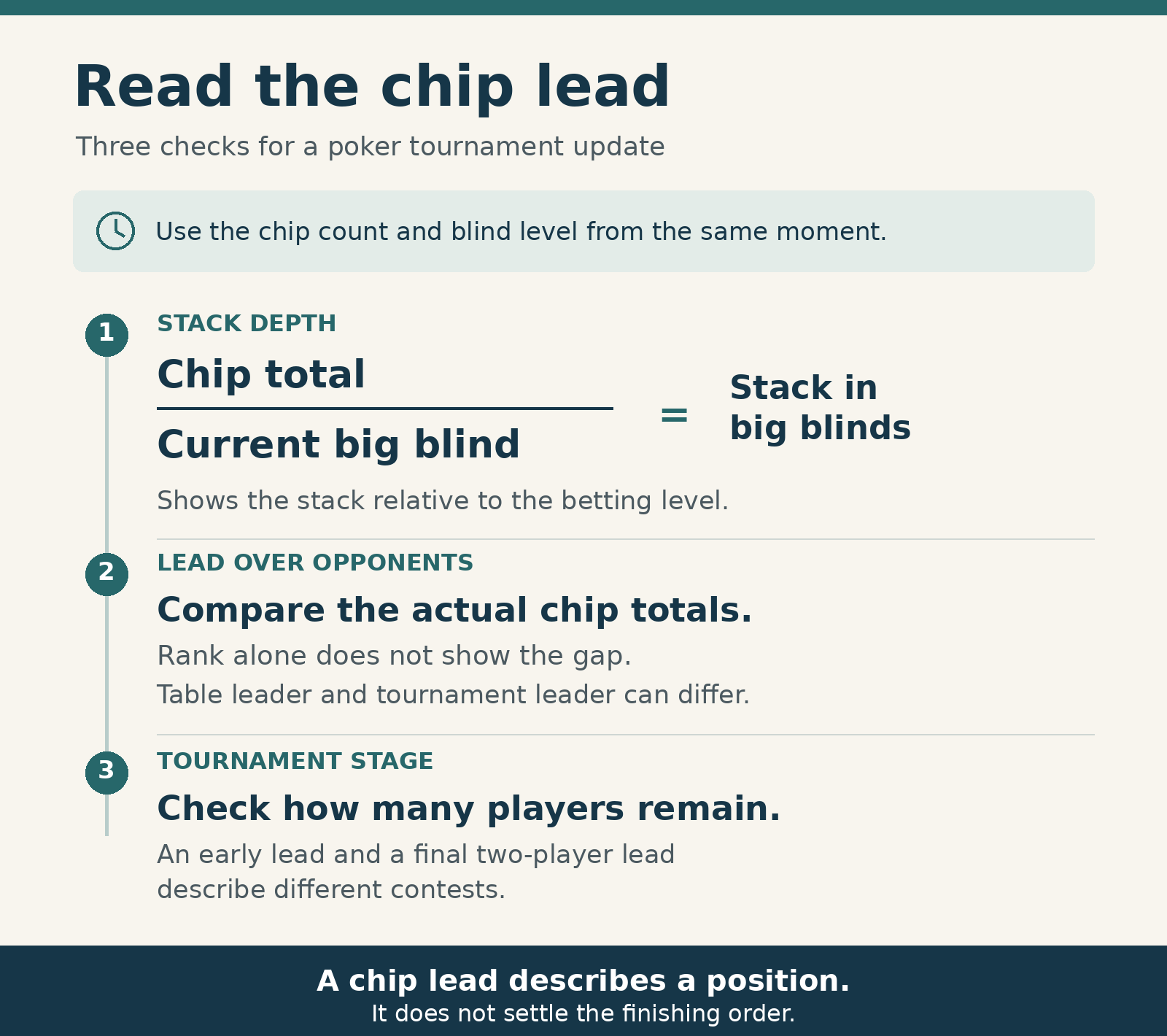
Divide a player’s chip total by the current big blind to express the stack in big blinds.
That calculation puts a large number into the scale of the game being played.
Use the blind level recorded alongside the chip count.
Combining an earlier stack with a later level produces a figure that may never have described the player’s actual position.
An unchanged stack represents fewer big blinds after the big blind rises.
A growing chip total can also shrink in big-blind terms if the compulsory bet increases proportionately faster.
An update reporting more chips therefore needs its accompanying level before it can be read as a deeper stack.
Big blinds are not a countdown of hands remaining.
Small blinds, any antes and subsequent betting also affect a player’s chips.
Antes are compulsory contributions paid separately from the blinds. The measure describes stack depth at that moment, not how long someone will remain in the event.
Compare the players who can meet
Before the field reaches one table, the tournament leader and the leader at a particular table can be different people.
The overall standings describe the field; the nearby stacks describe the opponents a player can face immediately.
Within a hand between two players, the smaller stack limits how many chips they can match against each other. This is called the effective stack.
A larger stack cannot make an opponent contribute chips they do not have, and an unmatched excess bet is returned.
When the larger stack calls a shorter opponent’s all-in, it retains chips beyond the amount matched.
Losing that contest alone therefore does not eliminate the larger stack. It can still change the leaderboard substantially.
Wilson’s final three-player contest included double-ups for both Umberto Ruggeri and Ignotas Kirsis against him.
He still had chips remaining, later eliminated Kirsis and faced Ruggeri for the title in heads-up play.
With several players involved, further matched bets between players who still have chips form a side pot.
A player already all-in cannot win those additional contributions. Keeping the pots separate explains why winning a hand does not always mean collecting every chip being contested.
Read the field, not just its average
Average stack is the total chips in play divided by the number of remaining players. It provides a reference point, but it does not identify the middle-ranked player or show how closely the leaders are grouped.
A few very large stacks can leave many competitors below that average. If the total chips in circulation remain constant, eliminations also push the average upwards without requiring an individual player to gain chips.
The complete count is more informative: compare the leader’s margin, the chasing group and the shorter stacks. Then check how many players remain.
Leading an early field and leading the final two-player contest involve very different amounts of unfinished competition.
Why the lead does not settle the result
Describing a position and forecasting a result require different evidence. A 2025 Frontiers study of Bundesliga football tested its predictions against actual match results, checking accuracy and whether predicted probabilities matched observed outcomes.
In poker, chip share records the proportion of chips a player holds. Treating it as a winning probability requires evidence beyond that calculation.
A percentage of the chips is consequently not, by itself, an independently measured chance of winning. Turning the count into a forecast requires assumptions beyond the count.
For Australian readers catching up on overseas tournaments, check the timestamp before comparing updates.
Read the stack alongside its blind level, relevant opponents and remaining field.
Wilson’s Irish Open run shows why: fifth in chips was a position during the competition. First place was the result after it finished.