FIFA World Cup 2026: Intercontinental play-offs preview - Bolivia, Suriname and Iraq
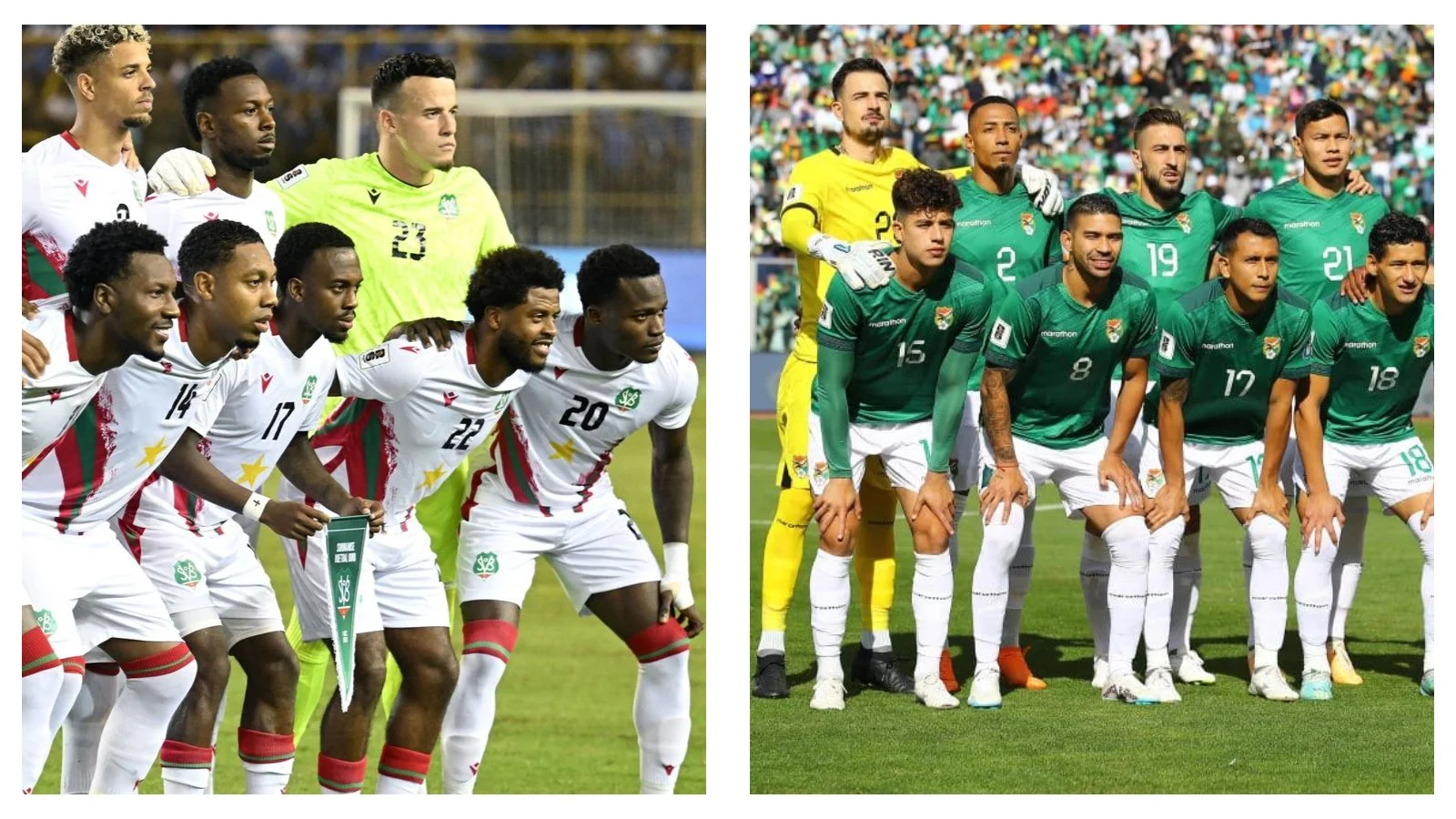
With the 2026 FIFA World Cup fast approaching, a mini-tournament of intercontinental play-offs is set to add two more teams to the main draw.
Scheduled for late March in Mexico, the action will feature six teams.
Here, Sports News Blitz writer AJ Becker takes a closer look at the three nations who will be taking part in Pathway 2 of the play-offs, following his preview of Pathway 2 last week.
Bolivia
ZONE: South America (CONMEBOL)
FIFA RANKING: #76
STRIP: Dark green top & white shorts
MANAGER: Óscar Villegas
PREVIOUS WORLD CUP APPEARANCES: 3
Mid-1990s heyday
The last time Bolivia were at the World Cup, it was the summer of 1994 and ‘Definitely Maybe’ was flying off the shelves.
Three years later, as the music world waited for ‘Be Here Now,’ ‘La Verde’ reached their first Copa América final in three decades on home soil.
The current incarnation of the Bolivia squad may well be their best since the mid-1990s, though Óscar Villegas’ side will be divested of their most potent weapon for the play-offs.
Home stadium altitude
Quite simply, their current home stadium - Estadio Municipal de El Alto - and its precedessor, Estadio Hernando Siles, are at altitudes well in excess of 10,000 feet.
The resulting lack of oxygen, reduced endurance, faster fatigue and breathlessness has caused many an away team to crumble; Brazil fell to defeat in El Alto last September, as did Colombia and three others.
Home & away
Such results, whilst undoubtedly impressive, may also have distracted attention from Bolivia’s horrendous away form - their victory in Chile 18 months ago ended a winless drought of some 66 matches in away qualifiers, stretching back to 1993!
From the 1998 campaign onwards, a meagre nine points have been accumulated away from Bolivia, compared to 116 at home.
Since the millennium, other countries which enjoy an altitude advantage have improved their away form sufficiently to secure a World Cup place (Ecuador, Peru), leaving the Bolivians in a relative stasis.
Nonetheless, if the play-offs see them recapturing the level of performance that took down the Seleção, Suriname (and then Iraq) may be hard-pressed to thwart them.
One of their own
Homegrown coach Villegas is a man well-versed in Bolivian football tradition, having spent the last 25 years managing club and youth teams in the country.
His command of the language of tactics is as eloquent as any of his European counterparts, and those memorable home performances have aligned his side in the great South American tradition of high-tempo attacking, defensive density and physical stamina.
Tactics & players
Villegas has deployed various formations, with his core of key players narrowed to a nucleus of four.
There is the talent and creativity of young forward Miguel Terceros, playing for Santos in Brazil and scoring 8 of Bolivia’s 18 qualifying goals.
There is the pace and vision of Ramiro Vaca in midfield. There is the reliability and versatility of left-sider Roberto Fernández, who plays his trade in Russia. There is the physical strength and aerial ability of Saudi-based centre back Luis Haquín, whose leadership and experience could nudge The Greens into outright contender status.
Even so, with so much of their squad playing their club football in Bolivia, it has to be a qualified “maybe” rather than a confident “definitely” as to whether they will “be here now” and return to the grandest stage in 2026!
CHANCES OF QUALIFICATION: Moderate
READ MORE: Premier League 2025/26 Mid-Season Predictions and Current Tactical Trends

Suriname
ZONE: North, Central America & Caribbean (CONCACAF)
FIFA RANKING: #123
STRIP: Red with green markings
MANAGER: Henk Ten Cate
PREVIOUS WORLD CUP APPEARANCES: 0
Geography & history
Numbering two-thirds of a million people and almost entirely covered by rainforest, Dutch-speaking Suriname is geographically in South America, though far removed from that continent in both a cultural sense and in the stylistic trends of their football team.
With the 2010 campaign their sole appearance in CONCACAF’s final 12 stage this century, and just 11 wins in 27 World Cup qualifiers during that timespan, the view that the ‘Natio’ were among the region’s perennial also-rans was becoming an ossified consensus.
Story so far
After a late winner against Puerto Rico helped secure top spot in the first group phase, gaining the full six points from El Salvador and a pair of creditable draws with Panama ensured that Guatemala were edged into third place at the round-robin stage.
Their next stop will be the intercontinental play-offs; the long-sought-after fantasy of Suriname at the World Cup is now inching into achievable territory.
Dutch connection
A significant number of Suriname’s playing personnel (both past and present) were born in, have heritage in, or play their club football in the Netherlands.
Indeed, they were the beneficiaries of a FIFA rule change that allows players with Surinamese heritage born elsewhere to represent the country.
Ten’s Commandments
It should therefore come as no surprise that under none of their former coaches has their style of play been much of a departure from the tried-and-tested Dutch footballing principles: 4-3-3, incisive passing, creative midfielders, overlapping full-backs.
The incumbent Henk ten Cate seems precision-engineered for implementing such methods.
He brings four decades of coaching experience, including spells as assistant manager of Barcelona and Chelsea, as well as stints in charge of clubs in his native Netherlands, where he remains a rather well-kept secret.
Key players
Mixing raw athleticism with individual flair is a combination that is deceptively difficult to pull off - much as other CONCACAF sides have tried.
The speed and artistry of winger Sheraldo Becker (Mainz), finishing ability of forward Richonell Margaret (Go Ahead Eagles) and passing quality of Justin Lonwijk in midfield (Fortuna Sittard) can be juxtaposed with the gritty defending of Shaquille Pinas - who plays in Saudi Arabia - physical presence of Georgia-based midfielder Dhoraso Klas and attacking thrust of former QPR left-back Kenneth Paal, now contracted to Antalyaspor in Turkey.
Verdict
In conclusion, Suriname are arguably a style unto themselves - mixing panache with pragmatism, style with substance.
At their best - such as in the 4-0 home demolition of El Salvador and the solid 1-0 wins over Martinique in CONCACAF Gold Cup qualifying - they pulled off every move with considerable finesse, finding a winning balance.
However, defensive frailties of the sort that occurred against Costa Rica in the Gold Cup itself (3-4) and away to Guatemala in World Cup qualifying (1-3) serve as a reminder that the Dutch blueprint can be their undoing as well as their inspiration.
If Bolivia and Iraq expose those weaknesses, this campaign will simply turn out to be a longer retread of ground they’ve covered before.
CHANCES OF QUALIFICATION: Moderate at best
YOU MAY ALSO LIKE: Premier League news: Can Wolves bounce back after Rob Edwards’ turnaround at Molineux?

Iraq
ZONE: Asia (AFC)
FIFA RANKING: #58
STRIP: All green
MANAGER: Graham Arnold
PREVIOUS WORLD CUP APPEARANCES: 1
Lions’ lifespan
Mexico '86 remains the sole World Cup participation for a nation rarely out of the headlines, though the late 2000s saw the ‘Lions of Mesopotamia’ win the Asian Cup and gain points at the Confederations Cup.
A semi-final placing at the former tournament in 2015, as well as a more recent trophy in 2023 (Arabian Gulf Cup), further showcased the team’s potential.
Moreover, both Uzbekistan and Iraq’s neighbours Jordan, will be making their World Cup debuts this summer under foreign managers - proving that national teams can assimilate, emulate and extrapolate whilst still retaining their own identity.
Story so far
After breezing through the first group phase in which teams outside the Top 100 (Indonesia, Vietnam, Philippines) provided the opposition, without exerting much effort or demanding a great deal of their players, Iraq ended the second group stage in third place behind South Korea and Jordan.
A costly away defeat to Palestine meant they missed out on automatic qualification, with a further chance for direct entry squandered by a draw with future World Cup hosts Saudi Arabia (in a three-team pool).
Even so, a slender 3-2 aggregate victory over the United Arab Emirates last November (thanks to a penalty scored in the 17th minute of stoppage time) kept their hopes alive, bringing them to a 21st and decisive encounter against either Suriname or Bolivia.
Arnold’s approach
Australian Arnold has played for, coached and managed his own national team to some success - assisting the great Guus Hiddink as the Socceroos made their first ever entry into the World Cup knockout stages in 2006, then repeating the feat himself as manager in Qatar four years ago.
Echoes of Hodgson
He often ventured into Roy Hodgson territory with his utilitarian coaching sensibilities whilst in charge of Australia - treading the ground of ultra-defensive formations and making a considerable virtue of set-piece routines, sometimes to an exhausting degree.
This mode of operation attracted detractors and admirers in equal measure, though the aforementioned UAE matches evinced that such an approach has allowed Arnold to take full advantage of his current resources.
Disciplined, organised and unconcerned with nuance, each player was used for maximum tactical impact - a textbook case of the whole exceeding its parts, as were Hodgson’s Switzerland and Finland sides.
Key players
Those at his disposal for the forthcoming play-off include target man striker Aymen Hussein, scorer of six goals at the 2023 Asian Cup and former Manchester United youth player Zidane Iqbal, a creative playmaker now at Utrecht.
The list includes Sweden-born box-to-box midfielder Amir Al-Ammari, based at Cracovia in Poland and scorer of that last-gasp penalty and experienced leader of the defence and aerial threat Manaf Younis.
New dawn?
Their unexpected Asian Cup success in 2007 - at a time when the country was in a state of chaos and carnage - shows that Iraq can engineer winning scenarios out of seemingly daunting challenges.
Now, with positivity having been heaped upon the nation in large doses following the UAE victory, a first appearance at the showpiece in 40 years would be a uniting force and send the populace into the highest of spirits.
CHANCES OF QUALIFICATION: Probable to likely
READ NEXT: Cheltenham Festival 2026: ‘Willie’s in the Bumper’ – but which one?