F1 vs NFL: Two sports, one question over women’s place at the top
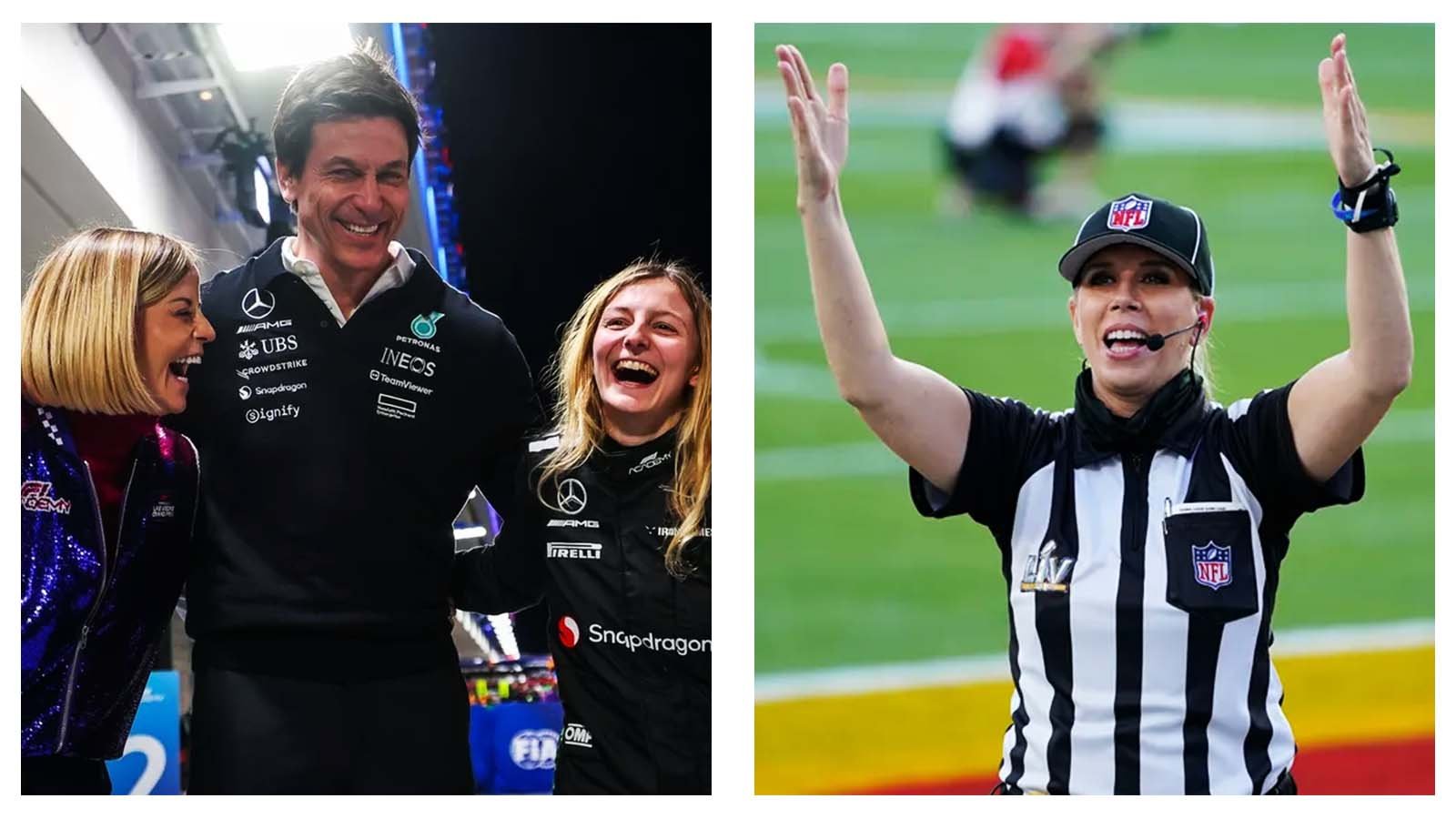
For years, girls were pushed away from muddy pitches and roaring engines, guided instead toward something “more appropriate”, writes Sports News Blitz’s Francesca O’Callaghan.
Fast forward to 2026, is that written narrative beginning to smudge, like ink on a page, or are we pretending that the sporting world is changing without reality fully catching up to it?
Take Formula 1 and the NFL.
In one corner, you’ve got a seemingly unrestricted, mixed-gender sport where the only real barrier is being one of the best drivers on the planet (no big deal).
In the other, a rigorously divided league where women aren’t even in the conversation when it comes to stepping onto the field.
Formula 1: Open in concept, limited in reality
Formula 1, arguably the biggest event in motorsport, claims to have never explicitly prevented women from competing, but does the history of the sport tell a different story?
Only five women have ever taken the wheel in a World Championship race, the most remarkable being Maria Teresa de Filippis, who pioneered in 1958, and Lella Lombardi, who remains the only woman to score a point in the sport to the extent that no woman has started a race since 1976.
Motorsport has always heavily relied on early investment, often beginning in karting, where entry costs, according to the BBC, begin at an astonishing £100,000, despite the FIA claiming that “improving accessibility and affordability” is a core priority.
In turn this has created substantial structural barriers for those with a lack of financial backing.
And for female drivers these barriers stretch beyond reach with a timid 13% participation at grassroot level.
Attempts to address this inequality have intensified significantly.
The introduction of F1 Academy in 2023 marked a meaningful shift, offering funding, coaching and track time to young female drivers.
READ MORE: Blancpain GT Endurance Series winner Abbie Eaton on breaking her back and racing again

Importance of support
Its first champion, Marta García, proved the importance of that support and encouragement that earned her a seat in the European Championship by Alpine the following year.
But queries remain about whether such strategies can translate into sustained presence at the very top.
Even prominent figures such as four-time world champion Max Verstappen have raised concerns, calling the cars "too slow" to prepare the drivers for Formula 1.
Progress beyond the grid
Susie Wolff has become one of the sport’s most influential figures, moving from test driver to managing director of F1 Academy, while continuing her advocacy through initiatives such as Dare to be Different, which has successfully promoted a culture of inclusion and supporting upcoming female talent as “it's not a man's world any more".
Technical roles are also evolving, with figures such as race engineer at HAAS, Laura Mueller, who was praised by Esteban Ocon when they first started working together for her "very impressive" trajectory and "flat-out" approach to work, highlighting gradual progress within these departments.
And the improvements and influence don’t stop there.
Content creators such as Lissie Mackintosh and a growing number of female-led podcasts are reshaping audience engagement, particularly among younger fans.
This had such a major impact to the point that women are a substantial proportion of Formula 1’s growing global audience - an estimated 300 million viewers.
YOU MAY ALSO LIKE: Tennis news: Emma Raducanu ready to return after tournament absences
The NFL: Exclusion on the field, expansion off it
In contrast, women do not compete in the league itself - but their presence across leadership, coaching, media and operations has expanded rapidly.
Sandra Douglass Morgan made history as the first black woman to lead an NFL franchise, becoming president of the Las Vegas Raiders, viewing it an “honour of a lifetime”, subsequently proving that the NFL is taking major steps to enable new faces and voices take their own stance in the game.
On the coaching side, Jennifer King became the league’s first black female assistant position coach, while Sarah Thomas broke new ground as the first woman to officiate a Super Bowl.
These milestones don’t just stop there.
In the 2023-24 season, 222 women held full-time roles in coaching or football operations - an increase of 141% since 2020.
“There has been remarkable progress,” said Sam Rapoport, the league’s senior director of diversity, equity and inclusion. “But we’ve only scratched the surface.”
NFL: Women in the media
Much like Formula 1, women are increasingly gaining a voice in media and content creation, from sideline reporters to digital storytellers.
Figures like Melanie Collins and Jen Hale from FOX and CBS have become integral to broadcast coverage.
The league has also invested heavily in engaging female fans, partnering with platforms such as Betches to expand its reach through producing relatable, pop-culture-focused football content which "mimics the way that women talk to each other," making football feel more accessible.
The success of this is evident through the fact that women now make up nearly half of the NFL’s fan base in the United States.
Furthermore, the ‘Taylor Swift effect’, the infamous appearance of Swift at Chiefs games, has not only generated an estimated $1 billion in brand value for the NFL but also resulted in a 53% increase in teenage girl viewership, cultivating a fresh, lasting demographic of passionate female fans.
The main difference
Formula 1 loves to say that anyone can race, but turning that into reality is like a slow pit stop with multiple barriers from money, to culture, and old habits.
The NFL, by contrast, moves faster off the field, bringing women into key roles - but has struggled to get them within the range to pass the ball on solid turf.
As Katherine Switzer, according to Run To The Finish, once said: “Life is for participating, not for spectating.”
READ NEXT: WSL news: Relegation battle heats up as new format takes shape