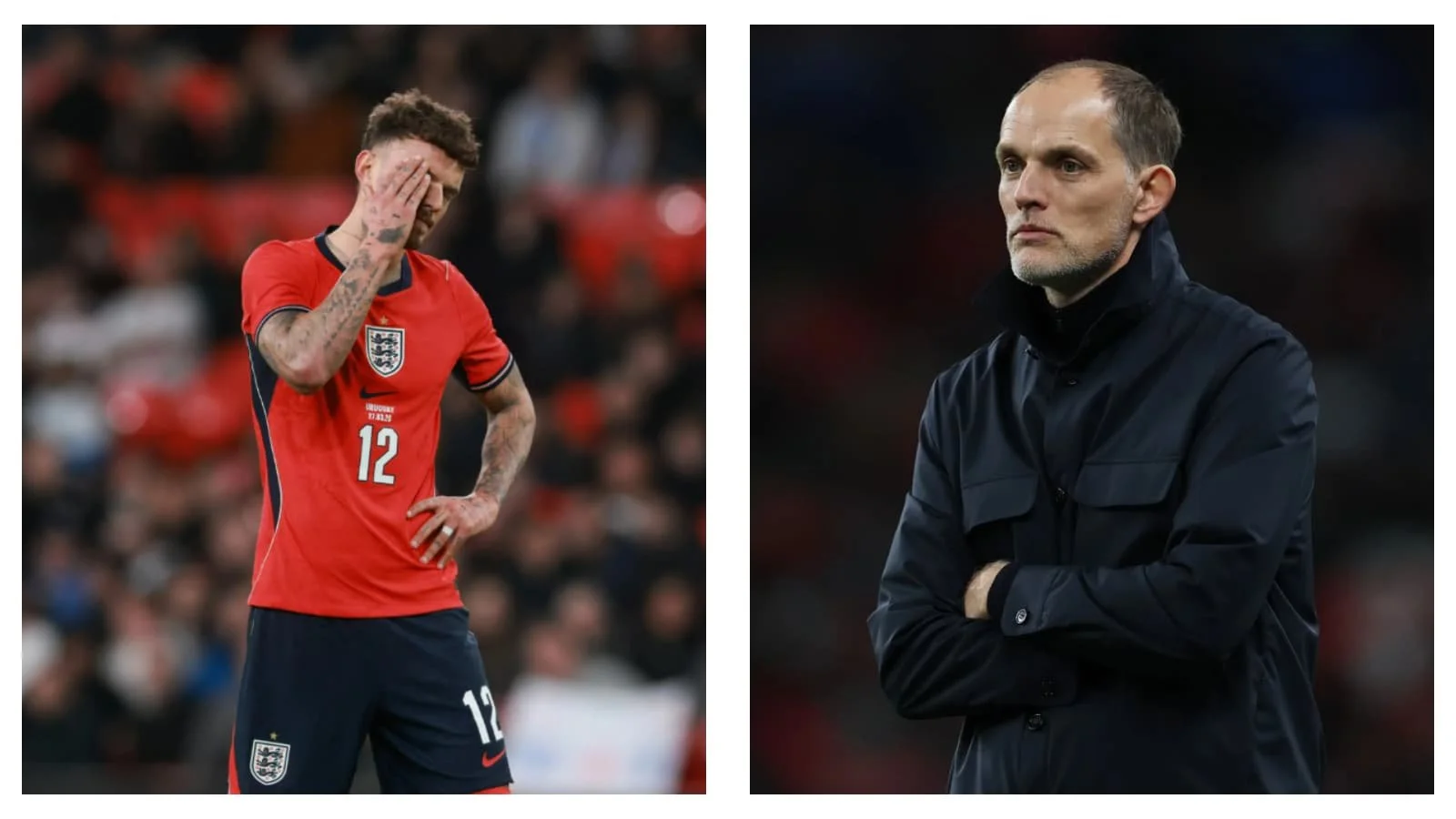
For a player whose international career has been overshadowed by questions about his commitment to England, Ben White delivered quite the answer in Madrid, writes Sports News Blitz’s Almonzer Hussain.
A goal against the reigning world champions, a crucial last-ditch tackle and an assured performance in one of England’s most significant victories under Thomas Tuchel.
On a night when the Three Lions ended Spain’s 43-match unbeaten run with a 3–2 victory, White demonstrated exactly why he belongs in the international conversation.
Yet only days earlier, the Arsenal defender was still being booed by sections of his own supporters.
It is a remarkable contrast, and one that raises an important question: how long should a player continue to be judged by a situation whose full circumstances remain unknown?
A story that has followed him since Qatar
White’s relationship with England supporters has been complicated since his early departure from the 2022 World Cup squad in Qatar.
The Football Association cited personal reasons at the time.
White subsequently made himself unavailable for selection during the remainder of Gareth Southgate’s tenure, leaving supporters with unanswered questions about what had happened.
His absence inevitably attracted criticism, particularly given the significance of representing the national team.
But criticism has often been accompanied by assumptions about his commitment, despite White never publicly providing a full account of the circumstances behind his departure.
Speaking ahead of England’s November fixtures, the defender suggested that supporters might view the situation differently if they knew the complete story.
He also made clear that he did not want to discuss others negatively in order to defend himself.
That distinction matters.
Supporters are entitled to question a player’s absence from international duty.
But there is a difference between asking reasonable questions and confidently judging someone’s character without knowing all the facts.
White has chosen not to publicly revisit every detail of what happened in Qatar.
Whether supporters agree with that decision or not, his silence should not automatically be treated as evidence of a lack of commitment.
Consistency without the attention
While the debate surrounding his England career continued, White remained an important part of Mikel Arteta’s Arsenal.
His versatility has been one of his greatest strengths.
Comfortable at centre-back or right-back, he offers composure in possession, positional awareness and an understanding of when to support attacks without compromising defensive responsibilities.
Those qualities are not always the most eye-catching, but they are valuable in a team built around structure and collective responsibility.
White was part of the Arsenal squad that finally ended the club’s 22-year wait for a Premier League title earlier this year.
Although injuries have disrupted his availability in recent seasons, his contribution to Arteta’s wider project should not be overlooked.
He is the type of defender whose qualities can sometimes be appreciated more fully when watching the entire match rather than individual highlights.
For England, those qualities are particularly relevant.
International football offers limited preparation time, and defenders capable of adapting to different tactical demands can provide managers with valuable flexibility.
A performance that changed the conversation
Sunday’s victory in Madrid offered a reminder of White’s quality at the highest level.
England had already established a two-goal advantage when White joined an impressive attacking move in the 57th minute.
Harry Kane’s hold-up play helped create the opportunity, Jude Bellingham supplied the pass, and White made a well-timed run into the penalty area before finishing through Unai Simón’s legs.
It was an excellent team goal, and White’s involvement highlighted an attacking dimension to his game that can sometimes be overlooked.
But arguably his most important contribution came at the other end.
England had been reduced to 10 men following Elliot Anderson’s dismissal, and Spain had recovered from 3–0 down to 3–2.
With the hosts pushing for an equaliser, Nico Williams threatened to break through on goal.
White’s sliding challenge in the 84th minute prevented the winger from getting a clear opportunity against James Trafford.
The tackle required timing, awareness and composure under considerable pressure. It was the kind of defensive intervention that can be just as decisive as scoring.
Trafford’s saves and the collective effort of England’s defence were also essential to preserving the victory.
White did not win the match single-handedly, but he made two contributions that directly influenced its outcome.
Against an opposition of Spain’s quality, that is a powerful reminder of what he can offer.
Time for a new chapter?
White’s return to international football has not been entirely straightforward.
He received a hostile reception when he returned against Uruguay in March, a match in which he scored before conceding a late penalty.
Injuries subsequently prevented him from representing England at the 2026 World Cup.
His international comeback has therefore involved setbacks as well as encouraging moments.
But Tuchel has repeatedly defended his inclusion, pointing to his quality and commitment since returning to the squad.
That support is significant.
England have considerable competition in defensive positions, and White should not be guaranteed a starting place because of one outstanding performance.
He should, however, be judged fairly alongside the other options available to the manager.
The debate over his England future should centre on what he contributes tactically, how consistently he performs and whether he improves the team.
There may never be a complete public explanation of what happened in Qatar.
White appears comfortable leaving parts of that story private.
And perhaps that is something supporters will eventually have to accept.
Four years on, the defender is back representing his country, competing for his place and delivering in demanding international matches.
In Madrid, he offered a reminder that commitment is not measured only through public statements or explanations.
It can also be demonstrated through preparation, performances and decisive moments when the team needs them.
Ben White cannot control every opinion about his past.
But against Spain, he made an increasingly convincing case for allowing his football to shape his future.